


 Barker Research · Published August 25, 2026 ·
 What the tranches are: senior and junior
jrUSDat is, in essence, a leveraged position in STRC. Under the current structure (data as of 2026-08-24 throughout this article), the leverage is roughly 4.3x: a 1% move in the STRC price moves jrUSDat's NAV by about 4.3% in the same direction. The leverage is funded by the senior tranche, srUSDat, within the same structure, and the cost of that funding is the senior target yield.
The structure is implemented by the Strata protocol. Strata splits Saturn's sUSDat yield strategy pool into two share classes: srUSDat (senior) and jrUSDat (junior, which is also the deposit asset of the Saturn × Barker Launchpool Season 2 campaign). Both classes invest in the same pool and share the same assets; the only difference is the order of distribution:
- When the pool earns, Senior is paid first, up to its target yield (currently 7.8% annualized, adjustable by the protocol); all excess above the target goes to Junior.
- When the pool loses, Junior absorbs losses first; Senior takes no loss until Junior's share value is fully wiped out.
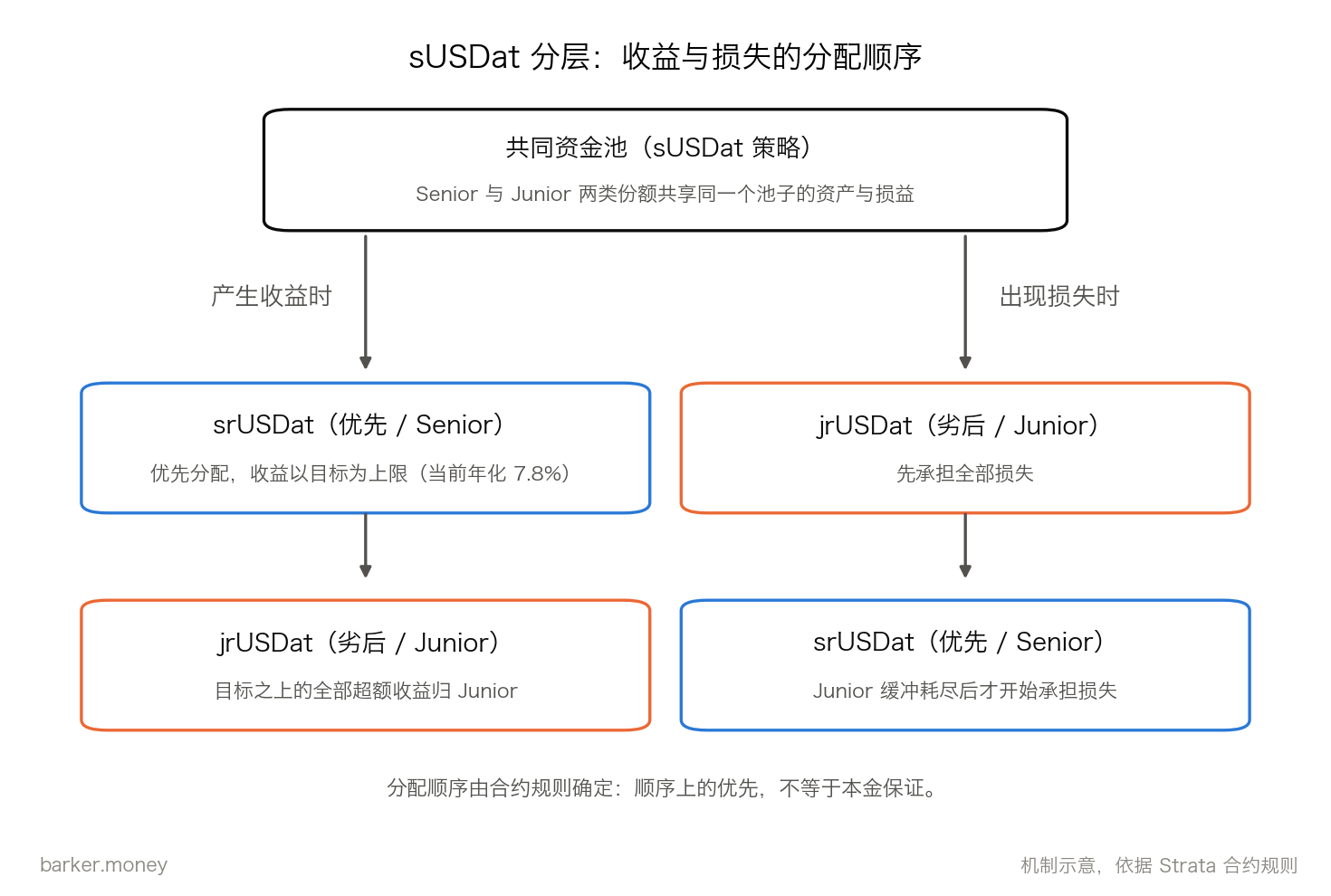
Distributions are split at the senior target yield (currently 7.8% annualized): up to the target, Senior is paid first; all excess goes to Junior. Losses flow in the reverse order. Priority in sequence is not a principal guarantee.
Two boundaries qualify the "leveraged STRC" summary. First, the senior target yield is a distribution priority, not a hard obligation: when the assets underperform, Senior may also fall short of its target. Second, the leverage multiple is not a fixed parameter; it shifts with price moves and with subscriptions and redemptions.
Junior can be purchased on its own, without pairing with Senior. Holding jrUSDat means holding the subordinated share of this structure: taking the first-loss position in exchange for the full claim on excess returns, with a NAV that moves daily in both directions.
Where the yield comes from: the STRC preferred stock
sUSDat's yield comes from STRC, a perpetual preferred stock issued by Strategy (formerly MicroStrategy, the largest bitcoin treasury company).
STRC pays dividends on a stated amount of $100 per share and carries no common-equity upside; its cash-flow profile is closer to a floating-rate note. The current dividend rate is 12% annualized, paid twice a month ($0.50 on the 15th and $0.50 at month-end). Strategy issues STRC to fund bitcoin purchases and pays dividends to STRC holders; that dividend stream is exactly what sUSDat collects.
Two preconditions apply to the dividend. First, each payment must be declared by the board, and the rate is adjustable under the terms: since listing in August 2025 the rate has been raised step by step from 9% to the current 12%, and rate adjustments also serve to anchor STRC's price near its $100 stated amount. Second, the ability to pay depends on Strategy's balance sheet. In early August 2026, bitcoin fell below Strategy's average purchase cost (about $75,000), and concerns over dividend capacity pushed STRC well below its stated amount; Strategy then sold part of its bitcoin to fund dividends and STRC buybacks and raised the rate to 12%, with the price recovering to around $97 (the contract's current valuation mark is $97.2). STRC's bond-like coupon is ultimately backed by the credit of a bitcoin treasury company.
STRC's discount or premium to its $100 stated amount reflects the market's combined pricing of Strategy's credit risk, liquidity, and the future dividend path. At the current annualized dividend of $12 per share and a price of about $97.2, the current dividend yield is roughly 12.3%. A deeper discount raises that current yield if the dividend is unchanged, but also signals that the market demands greater risk compensation. Because STRC is perpetual and its dividend rate can change, this is not a yield to maturity and does not mean the price must return to $100.
sUSDat is Saturn's yield-bearing dollar asset, with reported reserves held mostly in STRC. The Strata tranches cover only a small slice of sUSDat (about $7.45M, or 9%); the remaining 91% is held by other investors directly or through yield products such as Pendle:
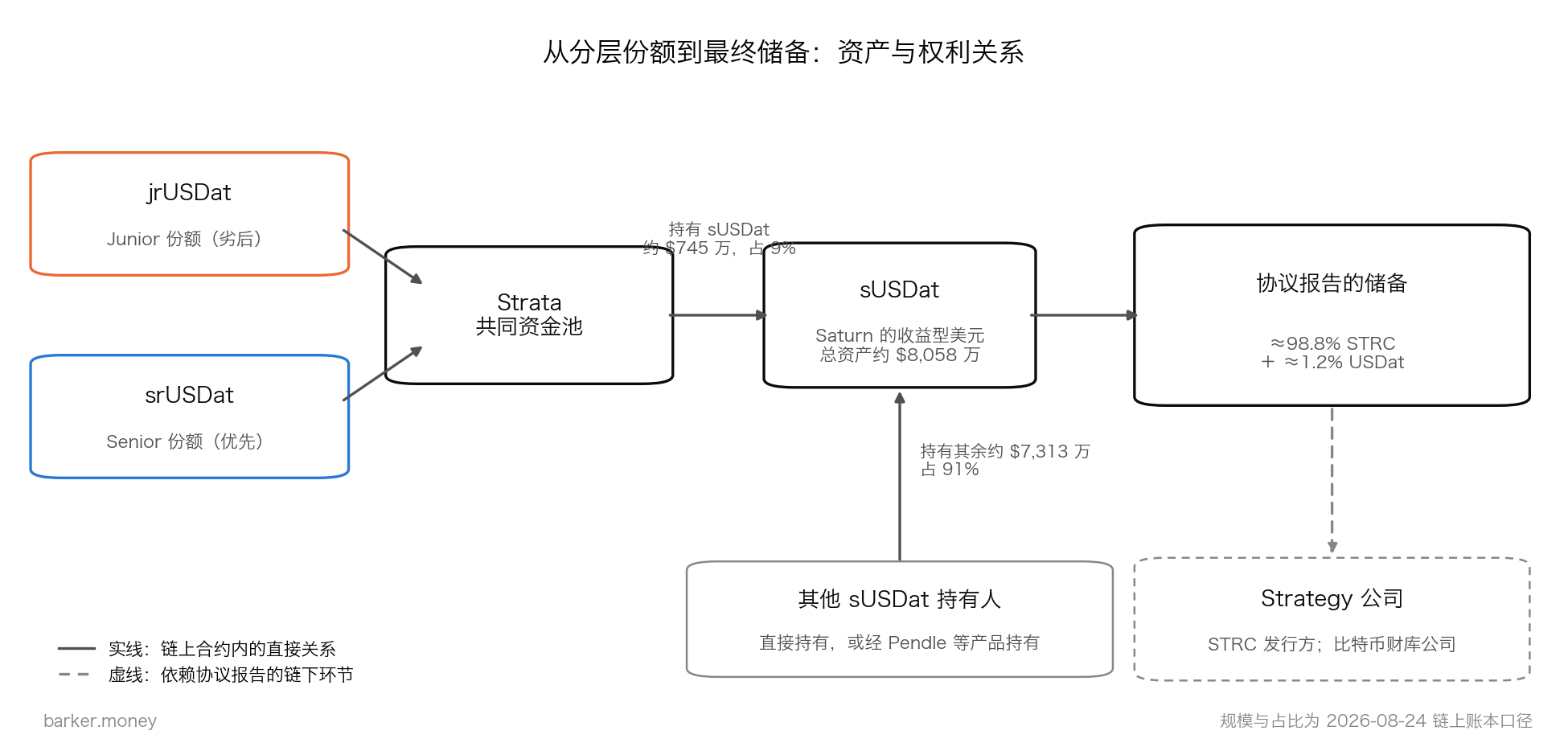
Solid lines are direct on-chain contract relationships; dashed lines are off-chain steps that rely on protocol reporting. Sizes and shares are per the on-chain ledger as of 2026-08-24.
| Reported reserve composition | Amount | Share |
|---|---|---|
| STRC (about 819k shares × contract mark $97.2) | ~$79.6M | ~98.8% |
| USDat | ~$0.97M | ~1.2% |
| Total (sUSDat total assets) | ~$80.6M | 100% |
Note: STRC quantities and values are ledger figures recorded in the contract and used for NAV calculation; brokerage and custody details rely on protocol disclosure. Deposits enter a common pool and do not map to any specific stock purchase.
How yield and risk move: leverage and how it changes
jrUSDat's volatility is approximately STRC's volatility multiplied by the leverage. Under the current structure (pool ~$7.45M, Junior ~$1.72M, STRC at 98.8% of reserves), the leverage is about 4.3x: each 1% move in STRC moves jrUSDat's NAV by about 4.3% in the same direction.
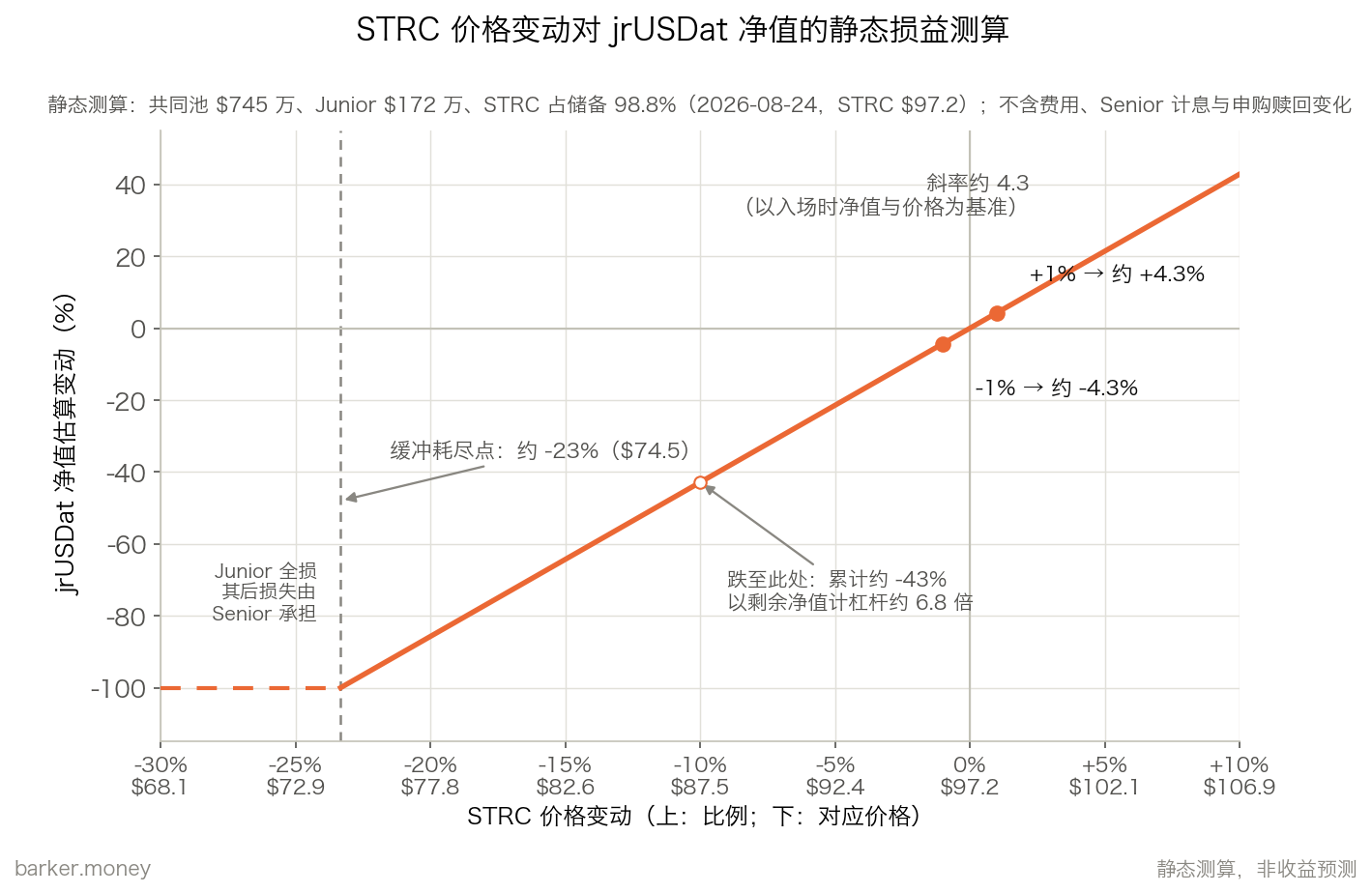
The static P&L is a piecewise straight line (measured against entry NAV and entry price): slope about 4.3, down to roughly −23% (about $74.5) where Junior's NAV reaches zero; losses beyond that point fall on Senior. Not a return forecast.
Under a static-structure assumption, the P&L line above is piecewise linear: starting from the current price, the slope is about 4.3 until STRC falls roughly 23% (to about $74.5), at which point the Junior buffer is exhausted and its NAV reaches zero; further losses fall on Senior. Actual results will deviate from this line due to fees, senior yield accrual, and subscriptions and redemptions along the way.
The leverage multiple itself is dynamic, driven mainly by three factors:
- Price level. The chart's slope is fixed because both its axis and its slope are measured against entry NAV and entry price; the leverage quoted at any moment, however, is measured against the remaining NAV and the current price, and the two diverge as prices fall. If STRC drops 10% from here, the cumulative loss from entry is about 43%, while the leverage measured on remaining NAV rises to roughly 6.8x, so subsequent moves of the same size hit noticeably harder; the reverse holds on the way up. This property matters especially for maintaining a hedge (see the appendix).
- Subscriptions and redemptions: procyclicality and path dependence. When STRC's discount widens, Junior redemptions become more likely. Once those redemptions mature and assets actually leave, the Junior buffer shrinks, increasing the leverage and downside sensitivity of the remaining shares; the buffer-exhaustion price can also move above the static level shown in the chart. Conversely, as the discount narrows, new Junior capital lowers leverage and dilutes existing shares' sensitivity to the remaining rebound. After a deep drawdown, jrUSDat is therefore unlikely to recover its original NAV even if STRC eventually returns to its starting price. This has already happened: jrUSDat's NAV per share was about $0.97 in early June 2026; although STRC later recovered to around $97 after a deep discount, jrUSDat was still only about $0.47 as of August 24.
- Structure parameters. The STRC share of reserves and adjustments to the senior target rate (currently 7.8%) both change the pass-through ratio.
The return side can be estimated in the same framework. At an STRC valuation of about $97.2, its $12 annual dividend corresponds to a current dividend yield of roughly 12.34%. Combining about 4.29x of STRC exposure with a Senior-to-Junior size ratio of about 3.34x gives a static implied Junior annualized return of approximately 4.29 × 12.34% − 3.34 × 7.8% ≈ 26.9%. This is static carry under the current balance-sheet structure, not realized APY, and excludes price moves, fees, subscriptions, redemptions, and structural changes; a few percentage points of STRC price decline can wipe out months of dividends.
The Barker campaign page's deposit panel shows an "estimated STRC price sensitivity" and an "estimated STRC exposure" scaled to your position, for reference. These estimates are derived from the on-chain structure and may lag; we recommend verifying them independently before acting on them.
Participating and exiting in practice
Depositing. You subscribe with USDat and receive jrUSDat; the share count is set by the NAV at subscription time. From then on, gains and losses are reflected in the NAV, with no manual claiming.
How yield lands. STRC pays twice a month, but payments do not hit the NAV instantly: dividends are processed and booked into the sUSDat ledger in batches, and each batch vests linearly into the NAV over about 3 days. This smooths the NAV and prevents opportunistic subscriptions timed around income booking. NAV growth is therefore continuous, with a slight lag after each payment date.
Exiting. Redemption takes three steps:
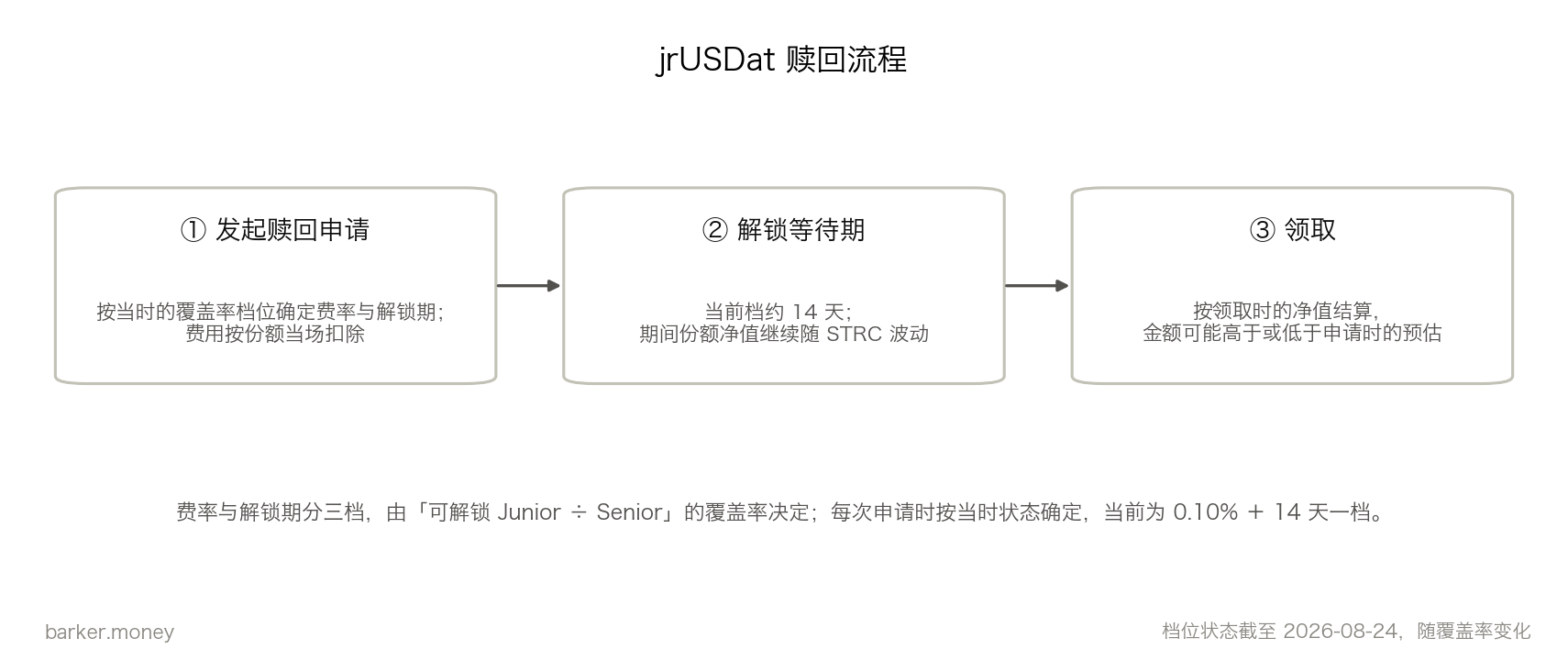
The fee rate and unlock period are fixed when the request is made; the final amount is settled at the NAV at claim time. The current tier is 0.10% + 14 days.
The fee and unlock period are set by the protocol's coverage ratio at request time, in three tiers:
| Coverage (unlockable Junior ÷ Senior) | Exit fee | Unlock period |
|---|---|---|
| Below 15% | 0 | 28 days |
| 15% – 30% | 0.10% | 14 days |
| Above 30% | 0.20% | 7 days |
Coverage is currently about 18.7%, placing exits in the 0.10% fee, 14-day tier. The fee and unlock period are fixed at request time (the fee is deducted from shares immediately), but the final amount is not: queued shares continue to move with Junior's NAV, and the amount received at claim may be higher or lower than the estimate at request time.
Appendix: hedging with the STRC perpetual — mechanics and costs (not recommended for users unfamiliar with perpetual futures)
jrUSDat's risk exposure comes from the STRC price, and an STRC perpetual exists on Hyperliquid, so the underlying price exposure can be partially hedged with a short position.
Hedging introduces additional costs and risks (margin, liquidation, funding, and more). We do not recommend hedging unless you are familiar with perpetual futures. This appendix explains mechanics only and is not a recommendation to act.
The instrument. xyz:STRC, a HIP-3 market on Hyperliquid operated by trade[XYZ]: a cash-settled perpetual whose oracle is anchored to the Nasdaq STRC spot price, with internal continuation pricing when the external market is closed, and a mark price that combines the oracle, basis, and order-book inputs. Maximum 10x leverage, isolated margin.
How much to hedge. Estimated exposure ≈ jrUSDat position value × current leverage (e.g., $1,000 of jrUSDat × 4.3 ≈ $4,300). You can hedge fully or partially. Because the leverage multiple keeps moving, maintaining a full hedge requires frequent rebalancing and the fee drag often outweighs the benefit, so a partial hedge is usually the more practical choice. The estimated exposure shown on the Barker campaign page is for reference only; verify it independently before sizing a position.
Leverage drift. As described above, falling prices raise the leverage measured on remaining NAV, and subscriptions, redemptions, and structure parameters also move the multiple; a large inflow of Junior subscriptions from this campaign would lower it. Hedge positions need to be re-estimated and adjusted against the current multiple on a regular basis.
Hedge horizon. If you plan to redeem after the 30-day campaign, note that redemption still queues through the unlock period (currently about 14 days), during which the exposure persists; the short should be held until the claim completes, roughly 44 days in total.
Trading costs. Standard-tier fees on xyz markets are 0.090% taker and 0.030% maker (tiered by 14-day volume). For $1,000 of jrUSDat hedged at roughly 70% ($3,000 notional short): round-trip fees are about $5.4 at taker or $1.8 at maker rates; annualized over 44-day cycles, open-and-close fees alone cost roughly 4.5% (taker) or 1.5% (maker) of principal, before rebalancing and slippage.
Margin and liquidation. When STRC rises, jrUSDat gains while the short loses. The two offset in theory but settle in different venues: unrealized jrUSDat gains cannot top up the short's margin, and if margin runs low the short is liquidated, removing the hedge at the worst possible moment. At 10x leverage, the minimum margin for a $3,000 notional short is about $300; in practice, several times that should be reserved.
Funding. Perpetuals settle funding hourly, and the direction is not fixed: when positive, shorts collect; when negative, shorts pay. The last 30 days of actual data:
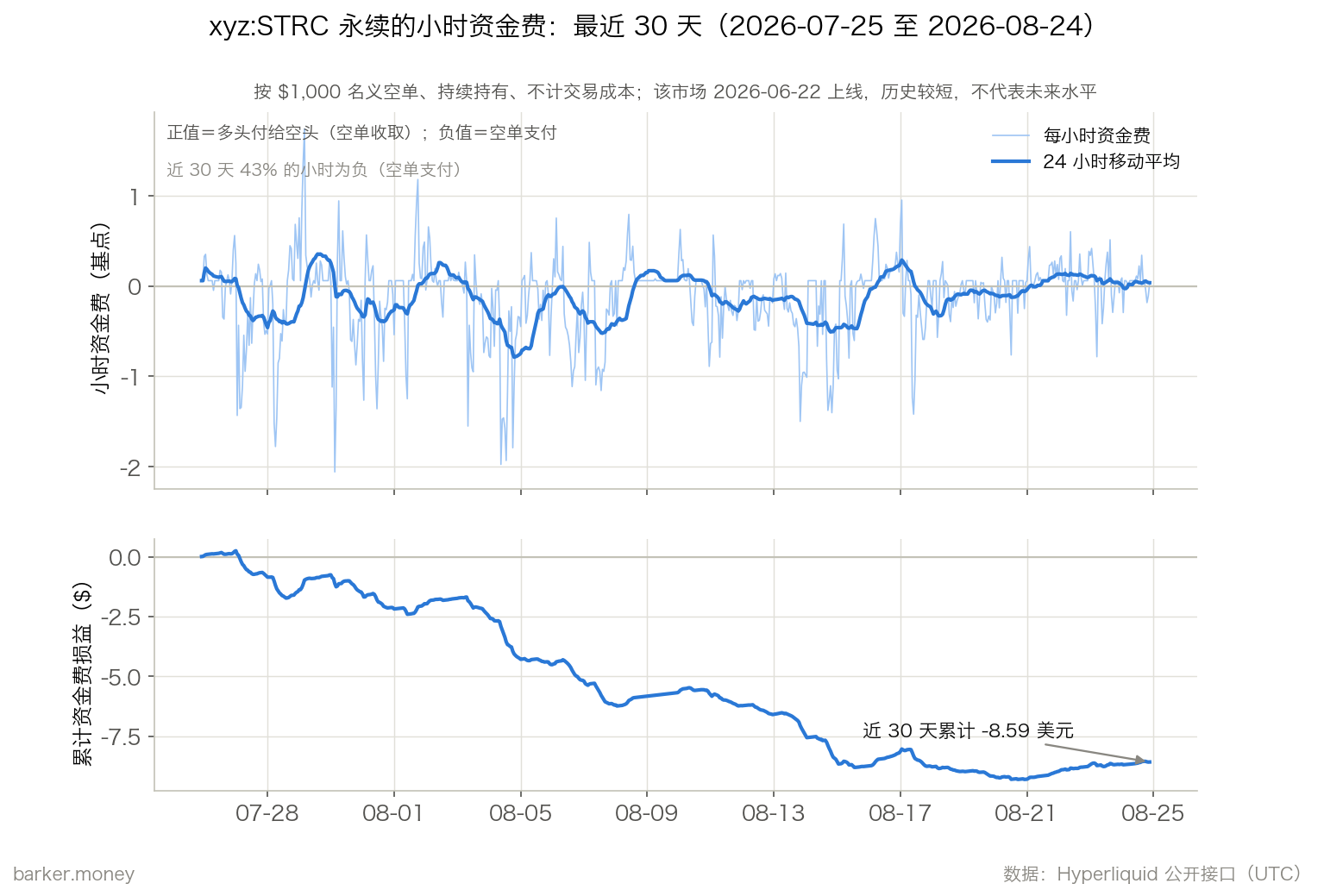
Hourly funding on xyz:STRC over the last 30 days (UTC); positive values are collected by shorts. The market launched on 2026-06-22; the short history is not representative of future levels.
Over the last 30 days shorts were net payers: about 43% of hours had negative funding, and shorts paid roughly 0.86% of notional in total. On a $3,000 notional short that is about $26 per 30 days, or about $38 over a 44-day hold, roughly 3.8% of $1,000 principal. Funding flips direction with the market: since launch, the full-period total is close to zero and slightly in shorts' favor. It cannot be locked in ahead of time and needs continuous monitoring.
What a short cannot cover. The following risks exist whether or not you hedge:
| Risk | Covered by a short? |
|---|---|
| Directional STRC price moves | Partially and approximately, with ongoing rebalancing |
| Reserves and custody (reliant on protocol reporting) | No |
| The perp's own pricing and execution (oracle, mark price, liquidity) | No |
| Margin, liquidation, funding | No; these are new risks added by the hedge itself |
Hedging is an active trade with its own costs and ongoing maintenance: it can reduce STRC price sensitivity at a point in time, but it cannot turn jrUSDat into a low-risk asset.
This article is based on public disclosures and public on-chain data, with all figures timestamped; the analysis and interpretation may contain inaccuracies and do not constitute investment advice.